When brands talk about affluent targeting, the conversation usually starts with income thresholds and broad geography. Target households earning over $250,000. Focus on the top ZIP codes in a metro. Layer in luxury interests and assume that the right audience will fall into place.
That approach sounds reasonable, but it oversimplifies how wealth actually behaves.
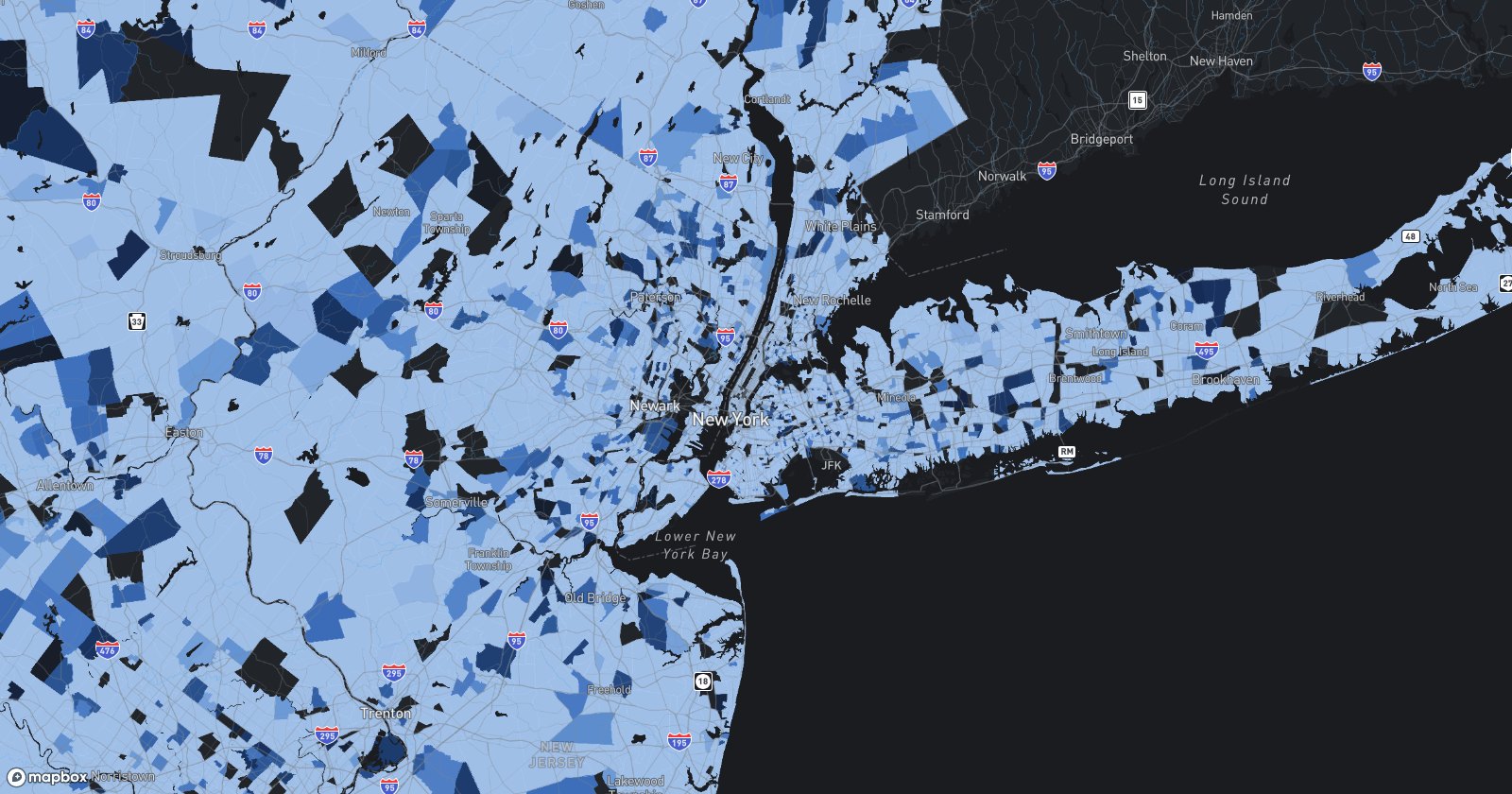
Wealth is not evenly distributed across a city. It concentrates. In nearly every major market, a relatively small number of neighborhoods account for a disproportionate share of total household assets. Once you move beyond state and ZIP-level summaries and examine data at the census tract or block level, the picture changes quickly.
Two ZIP codes can report similar median incomes while containing very different levels of actual net worth. One may include concentrated ownership of high-value real estate, business equity, and investment assets. The other may reflect strong annual income but limited asset accumulation. On paper, both look “affluent.” In practice, they represent very different levels of purchasing power.
For brands selling high-consideration products or services, that distinction directly affects media performance.
Income Is Not the Same as Net Worth
Income is often used as a proxy for wealth because it is widely available and easy to segment. However, income alone does not measure accumulated assets. A household earning $300,000 per year may not hold the same balance sheet strength as a household with $8 million in assets but a more modest annual income.
High-net-worth individuals tend to exhibit different financial behaviors. They may own multiple properties, hold significant equity positions, manage investment portfolios, or operate private businesses. These characteristics are not fully captured by income brackets.
When media targeting relies solely on income filters, it captures a broad range of households that may not align with the financial depth required for higher-value transactions.
Wealth Concentrates at the Neighborhood Level
In markets such as New York, Miami, London, Los Angeles, and Dubai, wealth clusters in identifiable residential corridors. These areas often share characteristics: high property values, proximity to financial centers, established social infrastructure, and long-term ownership patterns.
Within a single metropolitan area, a limited number of census tracts may contain a meaningful share of total investable assets. Outside of those areas, asset density drops quickly.
Targeting at the metro or ZIP level spreads media investment across households with varying financial profiles. Narrowing to the neighborhoods where wealth is concentrated reduces dilution and increases alignment with actual purchasing capacity.
This does not mean excluding broader audiences entirely. It means understanding where asset density is highest and structuring media strategy accordingly.
The Cost of Broad Affluent Targeting
The impact of this difference becomes more pronounced as transaction values increase.
If a brand sells a $500 product, reaching a broad upper-income audience may still produce acceptable performance. If a brand sells $25,000 services, $100,000 vehicles, or seven-figure investments, the margin for inefficiency shrinks significantly.
Broad geographic targeting increases impressions and sometimes clicks. It does not guarantee alignment with households capable of transacting at the highest levels.
When campaigns focus on verified wealth concentration rather than surface-level signals, media spend is distributed more intentionally. The objective shifts from maximizing reach to aligning with asset capacity.
Digital Behavior Reflects Physical Concentration
Physical location often correlates with broader financial indicators. Property ownership, business registration, and long-term asset accumulation shape consumer behavior. These signals influence the types of products individuals research, the publishers they frequent, and the purchasing cycles they follow.
Aligning media with real-world wealth distribution creates a stronger connection between audience identification and transaction outcomes. Instead of relying on contextual assumptions, brands can ground their strategy in verified financial depth and geographic concentration.
Why This Matters for Brands Focused on Higher-Value Transactions
For brands that prioritize transaction size over volume, precision matters more than scale.
Understanding where high-net-worth individuals actually live provides a structural advantage. It reduces wasted impressions, improves alignment between messaging and financial capacity, and supports long-term customer acquisition strategies focused on value rather than volume.
Affluent targeting is not simply about filtering for higher income. It requires recognizing how wealth accumulates, where it concentrates, and how that concentration can inform media deployment.
In higher-value categories, that shift in approach often makes the difference between broad visibility and measurable transaction growth.